
Establishing a reproducible baseline for squiggle-space algorithm development
Published:
August 2026: the R10 results on this poster are not correct due to a configuration error on my side, the corrected results are considerably better. Final numbers will be in the upcoming paper.
This poster was presented at the Flanders Nanopore Day.
Abstract
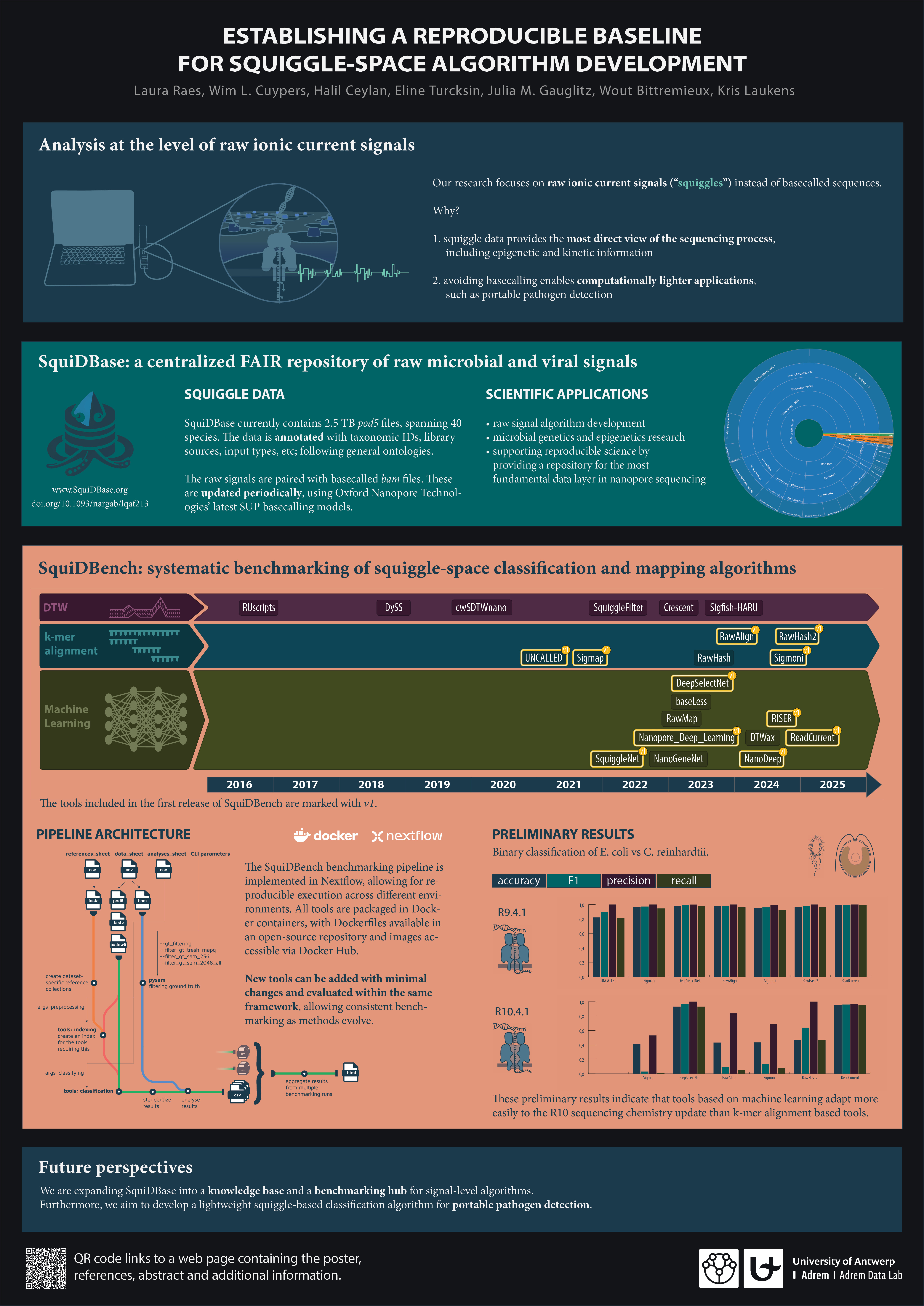
Nanopore sequencing enables real-time, point-of-care diagnostics through continuous signal streaming and compact devices. However, the high computational cost of basecalling remains a major hurdle. Raw signal-based algorithms bypass this issue, but their progress is hindered by a fragmented research landscape, poor reproducibility, and outdated datasets.
To address the data bottleneck, we built SquiDBase, a FAIR repository of raw microbial and viral signals with verified ground truth. Periodic updates using ONT’s latest SUP models keep raw signal research aligned with basecalling advancements. SquiDBase also enables microbial epigenetics research by providing the raw signal.
To introduce systematic reproducibility, we built SquiDBench, a Nextflow-based benchmarking framework for squiggle-space methods. Initial results reveal a critical performance gap: many tools trained on legacy data underperform on modern R10 signals, underscoring the need for benchmarks to advance the field.
Additional information
SquiDBase can be found at SquiDBase.org. It was published in January 2026 in NAR Genomics and Bioinformatics.